2.3 - Assembling Oxford Nanopore data
Overview
time
- Teaching: 15 minutes
- Exercises: 10 minutes
Objectives and Key points
Objectives
- Perform an assemble of a bacterial genome using the
ravenassembly tool.
Keypoints
- The
ravenassembler is one of several very powerful tools for assembling genomes from long read data. - Different tools may be better suited for different data, and long read assembly is still a developing field so if working with these data, make sure to experiment with multiple tools.
Introduction to raven
Although the gap is closing rapidly, Oxford Nanopore sequences are fundamentally more error prone than the sequences we obtain through Illumina sequencing and a considerable amount of assembly is spent identifying and correcting errors to produce high-quality contigs from a comparably low-quality set of reads.
Comparison of average sequence qualities on different platforms
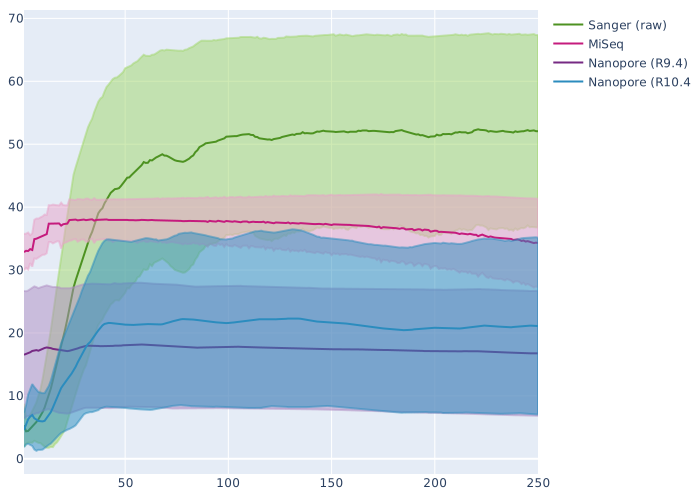
The median sequence quality for the Nanopore data produced using the (now retired 9.4 chemistry) data sits around Q20 for most of the sequence. This corresponds to 99% accuracy which might sound good, but by definition half of the sequences have lower quality than this. At the low end of this plot the sequences are slightly above Q10, which denotes 90% accuracy.
Finding consensus regions between pairs of reads, when one of them might differ by up to 10% of it's composition just due to sequencing error alone makes assembly a complicated process and assembly tools which are aware of the error profiles of our long read data are essential.
Why use raven?
The complete workflow of raven (Vaser et al., 2021) is quite complicated. For our purposes, the main points of the assembly process to understand are:
- Overlaps between reads are identified
- Identify problematic regions, such as chimeric reads
- Find new overlaps, removing incorrect connections
- Perform the initial assembly
- Identify suspicious connections in the assembly and remove them
- Polish the contigs using
racon
To run raven, navigate to your assembly_nanopore/ directory, and run the following command:
Unlike SPAdes, and many other assembly tools, we do not get much output from this tool. In the way we've run it only two files are created, and one of them is the assembled genome. For the purposes of the next exercise, we need to produce one more output file.
Exercise
Search the raven help information and run the tool again, producing an assembly graph for the next exercise.
A note on assembly tools
For the exercise today are using the raven assembler with one of the M. bovis genomes because it is fast and easy to use, while producing very high quality results. Like with other areas of genomics, there are many good options for assembly tools and our usage of raven today is in no way an endorsement that we consider this tool to be the 'best' long read assembler. raven is a very good tool and will give us good results with the data we process today, but when working with real data there are many other good options to try, including:
UniCycler(andTriCycler) (Wick et al., 2017) - https://github.com/rrwick/UnicyclerCanu(Koren et al., 2017)Flye(Kolmogorov et al., 2019)
A recent comparison of assembly tools was published by Wick & Holt (2021) tests some of the options listed above along with several other tools. Their manuscript is a 'living paper', which has been updated several times as new versions of each tool are released. Different assemblers have risen to the top at different time points, so this is very much still an evolving field, and it is difficult to say which assembler is the 'best'.
In practice, there are sometimes particular cases where a tool will not be compatible with your data, so it is helpful to be aware of several tools so that you have options if assembly proves problematic for a particular sample.